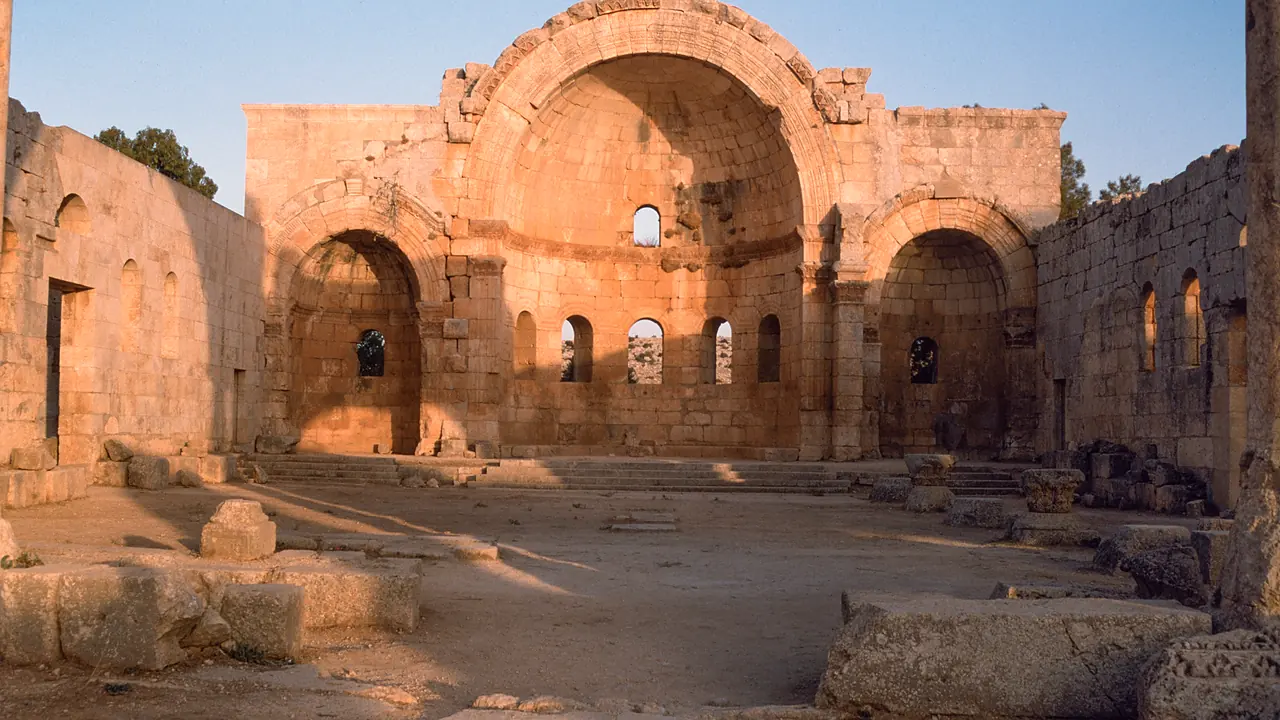
- Built by
- The emperor Zeno
- Period
- c. 473–490
- Role
- The liturgical church
- Size
- Largest of the four arms
- Dimensions
- to be confirmed
Provisional information. The highlighted values are placeholders awaiting the site survey and confirmation by the Directorate-General of Antiquities and Museums.
Of the four basilicas set against the octagon, the eastern one is noticeably the largest, and the reason is functional rather than decorative: this was the church proper. The other three arms brought people in and held them; the east arm held the altar and the services.
It is the clearest surviving demonstration of how the whole complex worked. Pilgrims arrived, moved through the western arm into the octagon, saw the column — and the liturgy that framed all of it took place here, on the east side, facing the direction the tradition required.
It is also, for a visitor today, the part of the ruin where the scale becomes legible. The octagon has lost its centre and the north and south arms are heavily reduced, but standing in the east basilica the size of the ambition is still readable in the ground plan.
Its dimensions, the surviving elevation, and the condition of the apse are to be recorded on the site survey.